
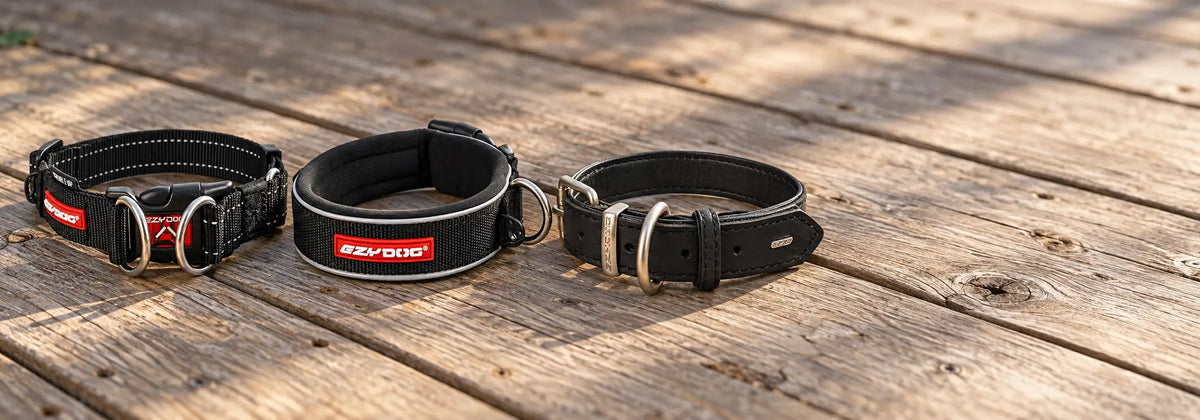
Best dog collar material: leather, webbing or neoprene?
Most collar guides cover size, buckle and width, then give material a single sentence about durability and move on.
It deserves more, because material decides how a collar behaves over years rather than weeks. How it handles salt water. Whether it softens or stiffens. What it looks like after two summers of beach walks.
We have been designing and testing collars on the Gold Coast since 1995, in all three of these materials, which means two things. We have watched each of them age in sun and salt water for three decades. And we have no reason to talk one up at the expense of another, because we sell all three.
The short version
| Full-grain leather | Soft touch webbing | Padded neoprene | |
|---|---|---|---|
| In our range | Oxford Leather Classic | Double Up including denim, corduroy and camo, plus Checkmate and Essential Adjustable | Neo Classic |
| Salt and water | Poor. Dries stiff | Good | Very good. Fast drying |
| Wear over years | Softens and improves | Holds its shape | Holds its shape |
| Comfort on a thin coat | Good once broken in | Good | Best. Padded |
| Cleaning | Wipe and condition | Wipe or hand wash | Wipe or hand wash |
| Smallest neck | 15cm | 22cm | 34cm |
| Widths | 15 to 25mm | 12 to 38mm | 30 to 35mm neoprene |
If your dog swims, neoprene. If you want leather anyway and live near the beach, expect to maintain it. If you want one collar to forget about, webbing.
Full-grain leather
Full-grain is the top layer of the hide with the grain left intact. That is why it takes a mark rather than flaking, and why a leather collar usually looks better at year three than year one. The Oxford is lined with padded PU on the inside, so the grain sits against the world and something softer sits against the dog.
Our Oxford Leather Classic runs from 2XS to XL, fitting necks from 15 to 62.5cm. The 2XS is the smallest collar we make, which matters if you have a toy breed and have been finding everything too big.
Where it wins. It softens to the shape of your dog's neck. It does not fray. On a short-coated dog the weight sits well and it stays where you put it.
Where it struggles. Salt water. Leather that gets soaked and dries without conditioning goes stiff, and repeated cycles of that will crack it. Rain is fine. An ocean swim every weekend is not.
Suits. Dogs who walk rather than swim, and owners who will do the occasional wipe and condition. Also anyone with a very small dog, since nothing else in our range goes below 22cm.
If you want a collar that looks better the longer your dog wears it, the leather dog collars are here.
Soft touch webbing
Webbing is the workhorse. It is what most of our range uses and it asks the least of you.
The Double Up uses our soft touch webbing across four sizes, fitting 22 to 71cm, in widths from 12 to 38mm. It carries two stainless steel D-rings, so leash pressure goes through those rather than the buckle, plus a separate D-ring for the ID tag.
Where it wins. It handles water without complaint, dries quickly and needs no looking after. It also comes in the widest range of widths of any material we use, so there is something proportionate for a whippet and something proportionate for a mastiff.
Where it struggles. It stays as it is. Webbing does not develop character the way leather does, and if that matters to you it will keep mattering.
Suits. Most dogs, most of the time. If you are not sure, this is the safe answer.
Denim, corduroy and camo
The Double Up also comes in three designer finishes. The construction underneath is the same soft touch webbing, so they handle water and wear the same way. What changes is how they look.
One thing worth knowing before you choose. The reflective stitching that comes as standard on our webbing collars is not included on the denim or corduroy versions. If evening walks are part of your routine, that is a real trade rather than a cosmetic one. The camo version keeps it.
Padded neoprene
Neoprene is the material wetsuits are made from, which tells you most of what you need to know about how it handles water.
The Neo Classic pads a neoprene layer over webbing. The neoprene runs 30 to 35mm wide depending on size, which makes it the widest collar in our range at every size except Extra Large, where the Double Up reaches 38mm. That width is the point, because it spreads the load across more of the neck.
Where it wins. Water and comfort. It dries fast, it does not hold moisture against the coat, and the padding suits dogs with thin coats or sensitive skin. For a dog that swims regularly it is the obvious choice.
Where it struggles. It is bulkier than the alternatives and it does not come small.
Suits. Swimmers, beach dogs, and dogs who have reacted to a thinner collar.
Which material for a dog that swims?
Neoprene first, webbing second, leather last.
Neoprene is built for it. Webbing handles it without trouble and dries quickly. Leather will survive the occasional swim but not a routine of them, and salt is harder on it than fresh water.
If you walk somewhere salty and want leather anyway, rinse it with fresh water afterwards and condition it every few months. That is a real commitment rather than a token one, so decide honestly whether you will do it.
Which material for a dog with sensitive skin?
Padded neoprene, because the padding spreads pressure across a wider area and there is no stitched edge sitting against the skin.
Webbing is next. Leather works once it has softened, though a new leather collar is stiffer than either alternative for the first few weeks.
Fit matters more than material here, whichever you choose. Our dog collar fit guide covers how to check it.
If your dog has ongoing skin irritation rather than a preference, that is worth raising with your vet before changing collars.
Which material lasts longest?
All three outlast most dogs' patience with a single colour.
Leather ages rather than wears, so it tends to be the one people keep longest, provided it has not been repeatedly soaked. Webbing and neoprene hold their shape and their strength, and what usually goes first is the colour rather than the collar.
Every EzyDog collar carries a one year warranty against material defects and workmanship, excluding chew damage.
Does width matter as much as material?
A wider collar spreads load across more of the neck, which is why width climbs with size. Our webbing collars run from 12mm on a Small up to 38mm on an Extra Large. Leather runs 15 to 25mm. Neoprene is 30 to 35mm across its range, which is wide by design.
A narrow collar on a strong dog concentrates pressure. A very wide collar on a small dog is just awkward. Match it to the dog rather than reaching for the widest available.
Frequently asked questions
What is the best material for a dog collar?
There is no single answer, which is why we make all three. Neoprene for dogs that swim, leather for dogs that walk and owners who will maintain it, webbing for everything else.
Is leather or webbing better for a dog collar?
Leather looks better over time and softens to the dog. Webbing handles water and needs no maintenance. If your dog swims regularly, choose webbing or neoprene. If not, it comes down to what you want to look at for the next few years.
Can a leather dog collar get wet?
Rain is fine. Repeated soaking is not, particularly in salt water, because leather dries stiff and eventually cracks. Rinse with fresh water after a beach trip and condition it every few months.
Is neoprene good for dogs?
It is the material wetsuits are made from, so it handles water well and dries fast. The padding also spreads pressure across a wider area of the neck, which suits dogs with thin coats.
How do you clean a dog collar?
Webbing and neoprene can be wiped down or hand washed in mild soapy water, then air dried. Leather should be wiped rather than soaked, and conditioned occasionally to stop it drying out.
What is the smallest collar material option?
The Oxford Leather Classic in 2XS fits a 15cm neck, and nothing else in our range starts below 22cm.


Read more
Leave a comment
This site is protected by hCaptcha and the hCaptcha Privacy Policy and Terms of Service apply.