
Is a microchip enough? Dog ID in Australia
Most owners think the microchip settles it. Chip goes in at eight weeks, details go on the register, done.
It is not done, and the gap catches people out.
The short answer
No, and the gap is wider than most owners realise.
Microchipping is compulsory for dogs across Australia. Separately, most states require a dog in public to wear a collar and tag. But in nearly every state the tag the law asks for is a council registration tag carrying a number, not your contact details. A number needs someone with access to the right database, which in practice means a vet, a shelter or a ranger during business hours.
New South Wales is the exception. Under the Companion Animals Act, a dog in a public place must wear a collar with a tag showing the dog's name and the owner's address or telephone number. Queensland has no statewide tag rule, and councils differ, so check yours.
So in most of Australia you can be fully compliant, chipped and tagged, and still have nothing on your dog that lets a neighbour who finds them at seven on a Sunday evening ring you.
That is the gap. Compliance and getting your dog home quickly are not the same thing.
The deadlines vary by state
Microchipping must happen by eight weeks in the ACT, before twelve weeks in New South Wales, Queensland and South Australia, by three months in Victoria and Western Australia, and by six months in Tasmania.
Council registration is a separate obligation on top, with its own deadline and its own rules. New South Wales runs a lifetime model through a state registry. Victoria registers annually through councils and requires the tag worn whenever the dog is off the property. Queensland registers through individual councils, with grace periods that differ from one to the next. South Australia runs one centralised system.
Because it genuinely differs by state and by council, check your own council's website for the current requirement and fee.
Two things most people have not done. Registering the microchip after it was implanted, since the implant and the database record are separate steps. And updating the details after moving house or changing numbers. A chip pointing at a disconnected number is no better than no chip.
That is the compliance part. The rest of this is about the part that actually gets a dog home.
Where the collar tag actually goes
The council tag and any engraved tag live on the collar, and where exactly they sit on it matters more than most people expect.
Clip a tag onto the same D-ring as the leash and two things follow. It rattles on every step, which some dogs mind more than others. And it wears, because a metal tag grinding against a metal clip for two years does not stay readable.
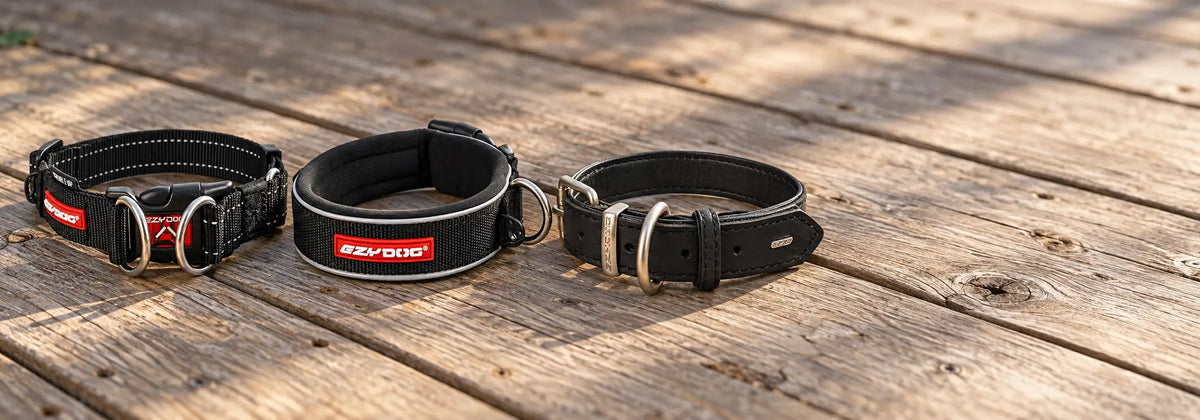
Some collars have a separate attachment point for exactly this reason. The Essential Adjustable Collar has an integrated ID keeper that holds the tag flat against the webbing. The Double Up Collar carries an accessory D-ring for ID alongside its two leash D-rings.
Either way the tag stays clear of the leash clip, which keeps it quieter and keeps it legible for longer. If you are choosing a new collar and your dog wears a council tag, it is worth looking for.
You can compare the range in the dog collars collection.
What happens when the collar comes off
This is the scenario nobody plans for and plenty of people experience.
A dog that spooks and backs out of a collar takes the collar with them, or leaves it on a fence. Everything attached to it goes too. The council tag, the engraved tag, all of it.
The chip is still there, which is the point of having one. But now you need someone to find your dog, contain them, and get them to someone with a scanner, which is hours rather than minutes.
A second point of identification fixes that specific failure. If your dog wears a harness on walks, putting your name and number on the harness as well as the collar means losing one does not lose both.
Putting ID on the harness
Our personalised labels attach to the sides of an EzyDog harness rather than being printed onto it, so a name and a phone number sit where a stranger can read them. They fit the Express, FORMFIT Mesh and Convert harnesses, and they do not fit collars, so collar ID still needs a separate tag.
Because they attach with hook and loop rather than being sewn on, you can move a set between harnesses or replace them when your number changes. That matters more than it sounds, since the most common reason ID stops working is that the contact details went stale.
We have covered the detail separately in why personalised name tags matter, including colours, character limits and turnaround.
Name only, or name and number?
Both work, and they do different things.
Name only is the common choice, and it is genuinely useful day to day. A stranger who can greet your dog by name calms the situation immediately, whether that is a vet, a groomer or someone who has just found your dog on the footpath.
Name and number turns the label into working identification. If your dog is loose and wearing the harness, whoever finds them can ring you without going anywhere.
You can also split it, since the labels come in pairs. Name on one side, number on the other.
What we would leave off. Your home address. It tells a finder where the house is and, by implication, that nobody is in it.
When the label needs to say something other than a name
Some dogs need the label to do a different job.
A dog who is nervous around strangers, recovering from surgery, working as an assistance dog, or simply still learning, is better served by a label that tells people how to behave than by one that tells them the dog's name.
Our pre-printed side labels cover that. Fourteen wordings in black and white, including Service Dog, Assistance Dog, Wheelchair Service Dog, Therapy Dog, In Training, Rescue Dog, Anxious, Nervous, Friendly, Ask To Pat and Do Not Pat, plus Blind Dog, Deaf Dog and Tripawd. They attach the same way, in a set of two, and they replace the standard logo panel on an Express or Convert harness.
Owners tell us the difference is immediate. A large dog wearing Friendly and In Training gets approached calmly instead of avoided. A dog wearing Do Not Pat gets left alone without the owner having to explain themselves ten times a walk.
It is a small thing that saves a lot of conversations.
Keeping ID readable
Whatever form your identification takes, it only works if someone can read it.
Check the collar tag occasionally. A metal tag that has spent two years rubbing against a D-ring is often illegible by the time it matters.
Review it yearly. Tie it to something already on a schedule, like a vet visit or a registration renewal. Contact details go stale quietly.
What we would actually do
Chip the dog, register the chip, and keep the details current.
Register with your council and put their tag on the collar.
Add your dog's name and your number as visible ID on the collar.
If your dog wears a harness, put the name and number on the harness too. That is the one that survives a collar coming off.
Frequently asked questions
Is a microchip enough on its own?
No. Microchipping is legally required across Australia, but it does not meet the separate visible identification requirements in most states. A chip needs a scanner. A name and number needs a stranger with a phone.
Does my dog legally need to wear a collar and tag in public?
In most Australian states, yes, though what the tag has to show varies. In New South Wales it must carry the dog's name and your address or phone number. In Victoria, South Australia, Western Australia and Tasmania the requirement is the council registration tag, which carries a number rather than your contact details. Queensland has no statewide rule, so check with your council.
Where should the tag sit on the collar?
Away from the leash clip if you can manage it. A tag on the same D-ring as the leash rattles and wears against the metal. Collars with a separate ID point, like the integrated ID keeper on the Essential Adjustable or the accessory D-ring on the Double Up, hold the tag flat and clear of the clip.
Can I put my phone number on a dog harness?
Yes. Personalised labels take letters and numbers, so your dog's name, your phone number, or one on each label since they come as a pair.
Do personalised labels fit collars?
No. They attach to the Express, FORMFIT and Convert harnesses, the Summit Backpack, Convert Saddle Bags and the bedding range. For collar ID you will need a separate tag.
Can I get a label that says something other than my dog's name?
Yes. Pre-printed side labels come in fourteen wordings, including Service Dog, Assistance Dog, In Training, Anxious, Friendly, Ask To Pat and Do Not Pat. They fit the Express and Convert harnesses and attach the same way as the personalised ones.
Will the labels come off in water or the wash?
They attach with hook and loop and are designed to stay put through normal use. Because they are removable, you can take them off before washing a harness and put them straight back on.
Can I change the name on a label later?
Not on the same label, since the text is printed. But because the labels attach with hook and loop rather than being sewn on, you can order a new set and swap them over without replacing the harness.
How long do personalised labels take?
Allow two business days for processing, as each set is made to order. They cannot be returned, so check the text carefully before ordering.
What should go on a dog's ID?
Your dog's name and a mobile number you answer. Most people leave the home address off.


Read more

Leave a comment
This site is protected by hCaptcha and the hCaptcha Privacy Policy and Terms of Service apply.